
Cognitive and perceptual play
Occupational therapists look at perceptual and cognitive development within the context of the infant’s occupations. Play in infancy contributes to early perceptual and cognitive development.
Perception and cognition can be discussed with parents as the baby’s early “thinking” skills.
Ways to encourage early thinking skills across the baby’s occupations are highlighted in the following handouts:
Cognitive and perceptual development in the context of play over three stages:
- Early Thinking Skills_Stage one (roughly 0-7 months)
- Early Thinking Skills_Stage two (roughly 6-12 months)
- Early Thinking Skills_Stage three (roughly 12 -24 months)
Container play helps the infant to develop awareness of 3 dimensional space as well and eye hand coordination. Further detail is provided in the following handout.
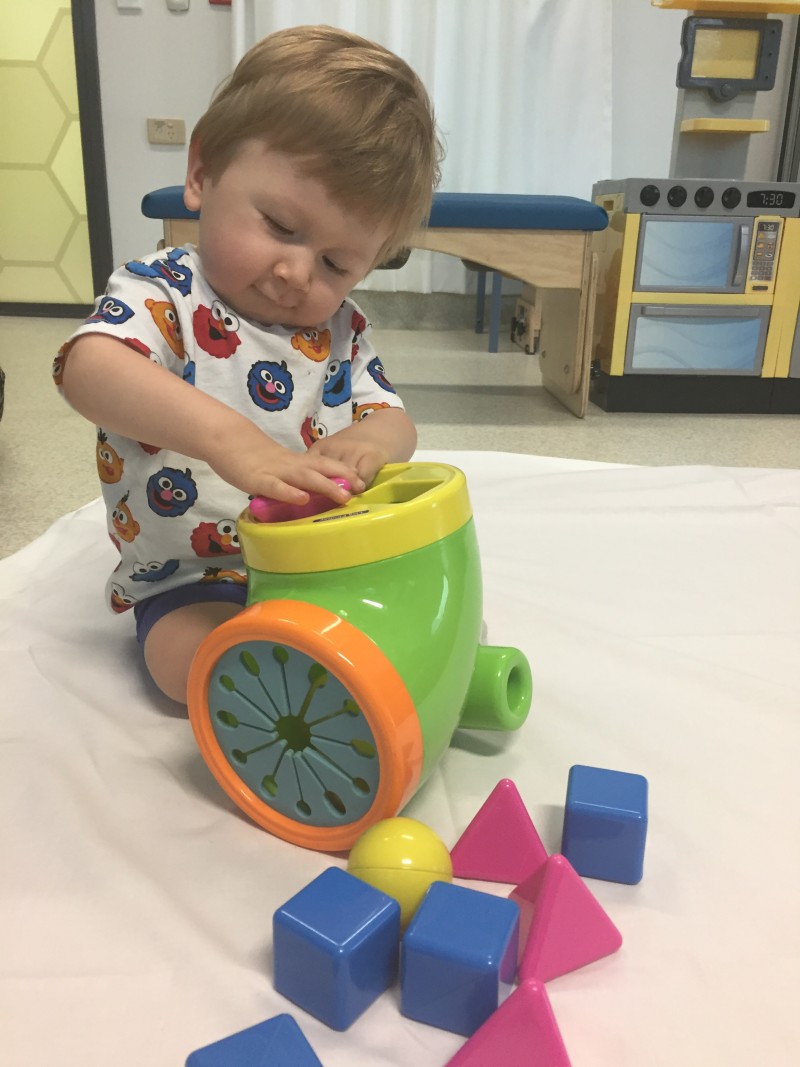

- Infants with developmental delays may need more modelling, time and repetition to become interested and engaged with a particular play stage.
- Multimodal cues (e.g. using a consistent engaging sound when posting a shape into a container, using a noisy metal bowl) may help engage the baby’s attention
- Talk to parents about preparing for the next stage of play by making appropriate toys available and occasional modelling without the expectation of progression
- Use the caregiver’s knowledge along with your assessment knowledge to identify what will support best performance (e.g. sensory environment, postural support, cues)
