
Burn size
The size of a burn is determined by systematically measuring the total body surface area (TBSA) of the burn on the child. This measurement is accurately obtained using an assessment tool and is recorded in the child’s referral letter/medical chart.
Assessing TBSA
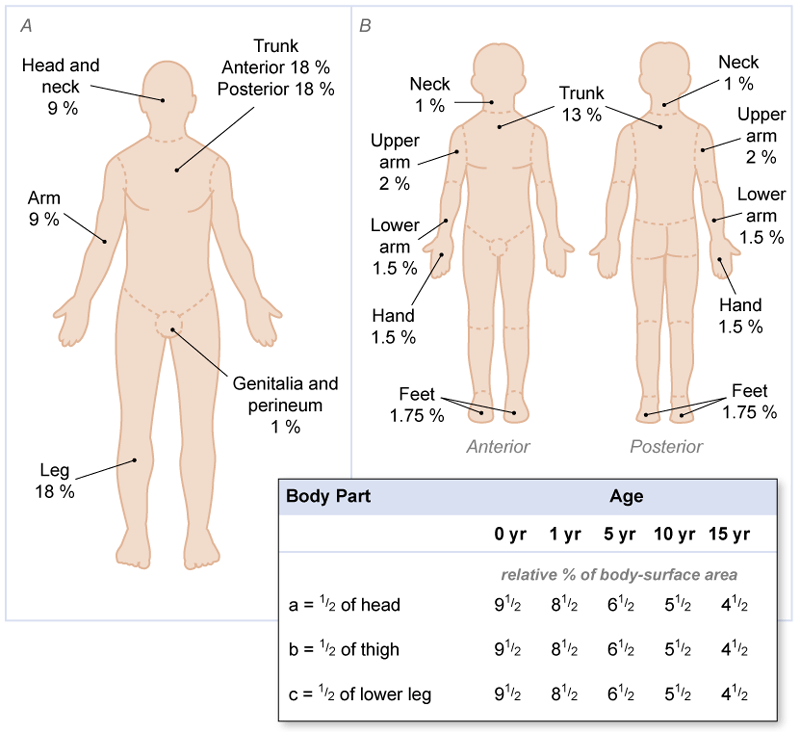
The area and depth of the burn are both shaded onto a diagrammatic representation of the body with each body part representing a percentage amount. These amounts are totalled to equal the total TBSA of the burn.
For example: A child sustaining 20% TBSA indicates a child has sustained a burn to 20% of their body. Looking for a tool measuring a child’s TBSA is a suggested way of determining the location and depth of the burn if you were unable to see the burn on the child’s skin due to dressings. Visual examination of an undressed burn wound however is the ideal.
The percentage amount corresponding to the child’s body changes with the child’s age. This is due to proportion sizes of body parts changing as a child grows. Accurate estimation of the TBSA of a burn is important as it contributes to the overall clinical picture of the burn injury and assists in determining the medical management of the child.
The NSW Institute of Trauma and Injury Management (ITIM) have a free downloadable app with resources to assist with calculating a child’s TBSA. Please see the Resources page for more information.
The size of a burn is determined by systematically measuring the total body surface area (TBSA) of the burn on the child. This measurement is accurately obtained using an assessment tool and is recorded in the child’s referral letter/medical chart.
Assessing TBSA
The area and depth of the burn are both shaded onto a diagrammatic representation of the body with each body part representing a percentage amount. These amounts are totalled to equal the total TBSA of the burn.
For example: A child sustaining 20% TBSA indicates a child has sustained a burn to 20% of their body. Looking for a tool measuring a child’s TBSA is a suggested way of determining the location and depth of the burn if you were unable to see the burn on the child’s skin due to dressings. Visual examination of an undressed burn wound however is the ideal.
The percentage amount corresponding to the child’s body changes with the child’s age. This is due to proportion sizes of body parts changing as a child grows. Accurate estimation of the TBSA of a burn is important as it contributes to the overall clinical picture of the burn injury and assists in determining the medical management of the child.
The NSW Institute of Trauma and Injury Management (ITIM) have a free downloadable app with resources to assist with calculating a child’s TBSA. Please see the Resources page for more information.

Key Point
TBSA, burn depth and time since the burn are predictors of scarring severity after a burn [7].
