
Debriefing models
Below are examples of three different models commonly used in debriefing.
Modified Pendletons
A common model for giving feedback in clinical education settings, this is a structured method to provide feedback to learners.
How did it feel?
Eliciting emotional reactions
What went well and why?
Reinforcement
What could be done better and how?
Change
What will you do next time?
New learning experimentation
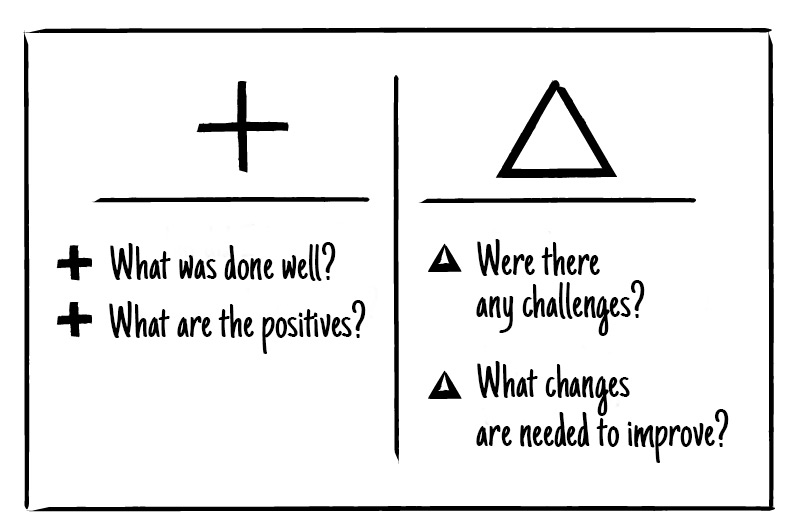
PLUS + / DELTA Δ
Plus/Delta is an inclusive strategy that enables participants to consider the things that went well (+) and the things that they could change (Δ).
Examples of questions that can be used to incorporate the Plus/Delta technique in a structured debriefing session are:
Advocacy-inquiry
Advocacy allows the facilitator to share their objective observations and subjective judgement of the participant’s actions and then asks for an explanation of the thoughts or actions of the participant.1,2 Inquiry then allows the facilitator to come from a stance of genuine curiosity as to what led the participants to take those actions, revealing the participant’s frames that can then be explored and reset if required.
I saw (objective observation) - 'I saw there was a long delay in starting chest compressions when the patient suffered a cardiac arrest ...'
I think (subjective judgement) - '....that concerned me because early effective compressions are required when a patient suffers a cardiac arrest and it appeared to me the team did not recognise the urgency...'
I wonder (genuine curiosity) - 'Can you tell me what was happening at that time?'
1. Rudolph JW, Simon R, Rivard P et al. Debriefing with good judgement: Combining rigorous feedback with genuine inquiry. Anesthesiology Clinics 2007;25(2):361-376.
2. Lopreiato J O. Healthcare Simulation Dictionary. Rockville, MD: Agency for Healthcare Research and Quality; October 2016. AHRQ Publication No. 16(17)-0043. Available from: http://www.ssih.org/dictionary
