
Plot and trend
ORC – Failure to recognise and escalate care
The ability to recognise and respond to signs of patient deterioration in a timely manner plays an important role in positive patient outcomes. Any delay in escalation of care compromises patient safety.1
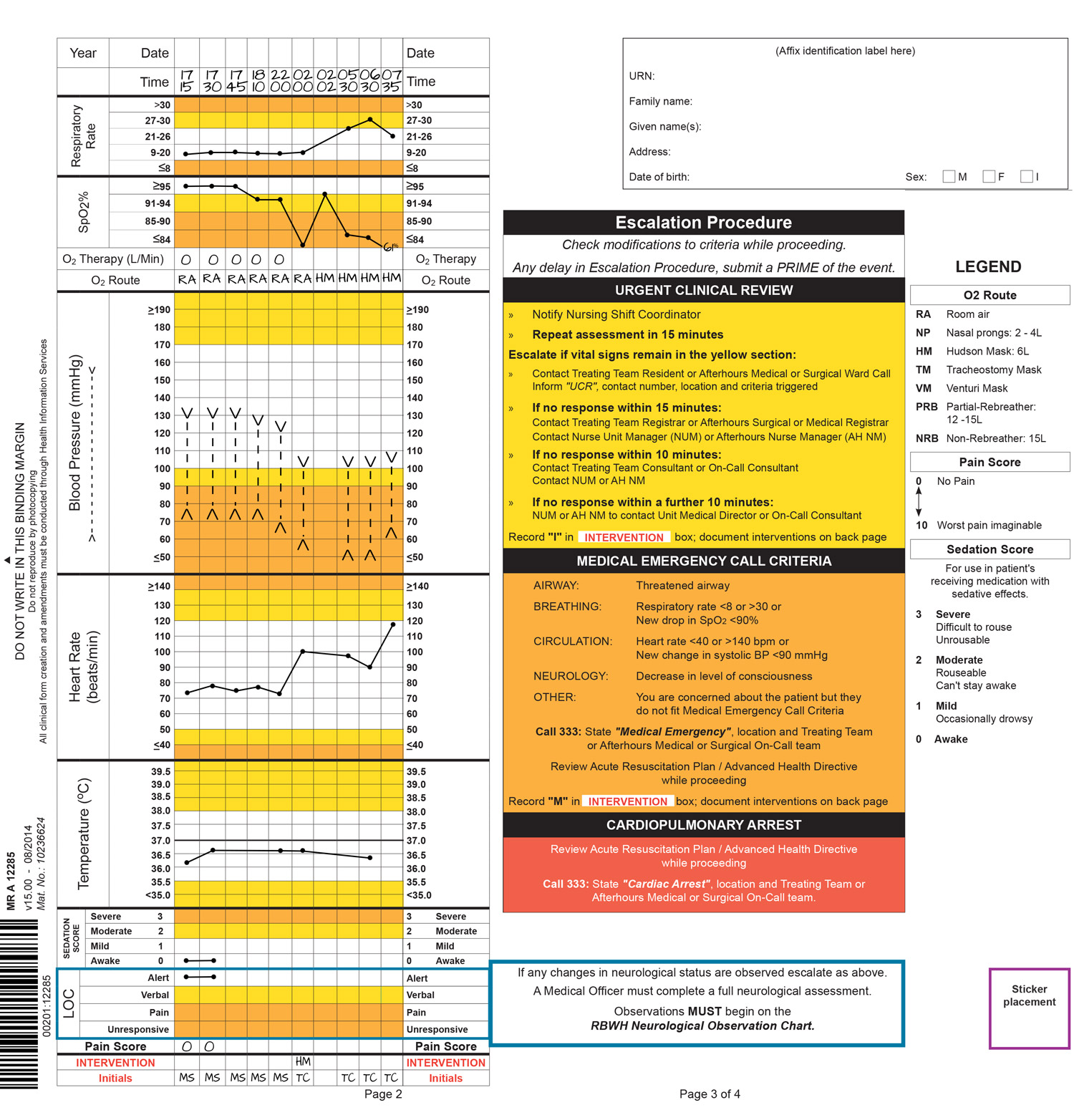
The documentation of vital signs in an observation response chart provides the clinician with an overview of the patient’s condition. Detecting changes or trends in the vital signs is a critical part of recognising clinical deterioration.2
The below observation response chart shows the plotting and trending of the deterioration of a patient’s condition which was not recognised by the clinician. Unfortunately due to this lack of recognition and escalation of care the patient did not survive.
Note: the ORC chart used for this interaction is the single track and trigger chart.
End of track and trigger chart
1 Johnston M.J., Arora S., King D., Bouras G., Almoudaris A.M., Davis R. & Darzi A. (2015) A systematic review to identify the factors that affect failure to rescue and escalation of care in surgery. Surgery 157(4), 752–763.
2. Australian commission on Safety and Quality in Health Care. Standard 9 Recognising and Responding to Clinical Deterioration in Acute Health Care. Safety and Quality Improvement Guide.Sydney. Commonwealth of Australia October 2012. Available from: https://www.safetyandquality.gov.au/wp-content/uploads/2012/10/Standard9_Oct_2012_WEB.pdf
