
Learning Objectives and Outcomes
Learning objectives should be based on an accurate needs assessment, clearly state the purpose of the educational event, and inform its development. Learning objectives should be kept to a minimum to help focus the event, and to avoid overloading participants with too much information.
Learning outcomes highlight the specific improvements or changes in knowledge, skills, and behaviours that can be observed or measured as a direct result of the education event. Learning outcomes should contain the following.
- Observe and measure performance that should match with the underlying competencies gained from the needs analysis.
- Identify what the learner will be able to do as a result of the training—the trainer works specifically towards these end results, and the learner has a clear understanding of what they are expected to be able to do at the end of the program.
- Designed to focus on the learner and their actual performance. (Tovey and Lawlor, 2008, p. 190).
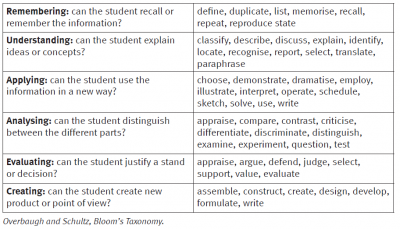
Bloom’s taxonomy is a model that can be used to help write learning outcomes. It describes levels of achievement that can be attained across the domains of learning.
QuizzesStatus
