
Implementation Science in Healthcare
Lets define how implementation science can be use in healthcare.
Implementation is the use of strategies to adopt and integrate evidence-based health interventions and change practice patterns within specific settings. It seeks to understand the behavior of healthcare professionals and other stakeholders as a key variable in the sustainable uptake, adoption, and implementation of evidence-based interventions.
The focus of implementation science is behavioural and cognitive decision making and influencing sciences (Safety II), rather than quality improvement reasoning which often drives a safety through compliance culture (Safety I). Safety I and II will be explored on the next page.
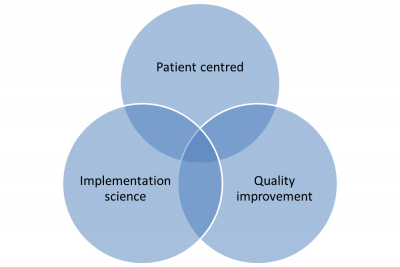
Implementation science, quality improvement and patient centered care all share the ultimate goal of improving the quality of healthcare. Methods used in the three fields often overlap, although there are some differences.
Implementation science
Implementation science typically begins with an evidence based performance gap. Implementation science has a focus of developing generalised knowledge that can be widely applied beyond the individual system under study.
Quality Improvement
QI efforts usually begin with a specific problem in a specific healthcare system, this leads to the design and trial of strategies to improve the identified issue.
Patient centered care
Patient-centred care is health care that is respectful of, and responsive to, the preferences, needs and values of patients. The widely accepted constructs of patient centred care are respect, emotional support, physical comfort, information and communication.
